Coating Exposed-Fastener Metal Roofs
Exposed screws back out as panels move with each season, and their rubber washers harden and split. We tighten the firm ones, swap stripped ones for oversized fasteners, and give every head its own detail coat.
As an Omaha commercial metal roof coating contractor, we fix screws, laps, and rust on warehouse and plant roofs, then coat the whole roof in place.
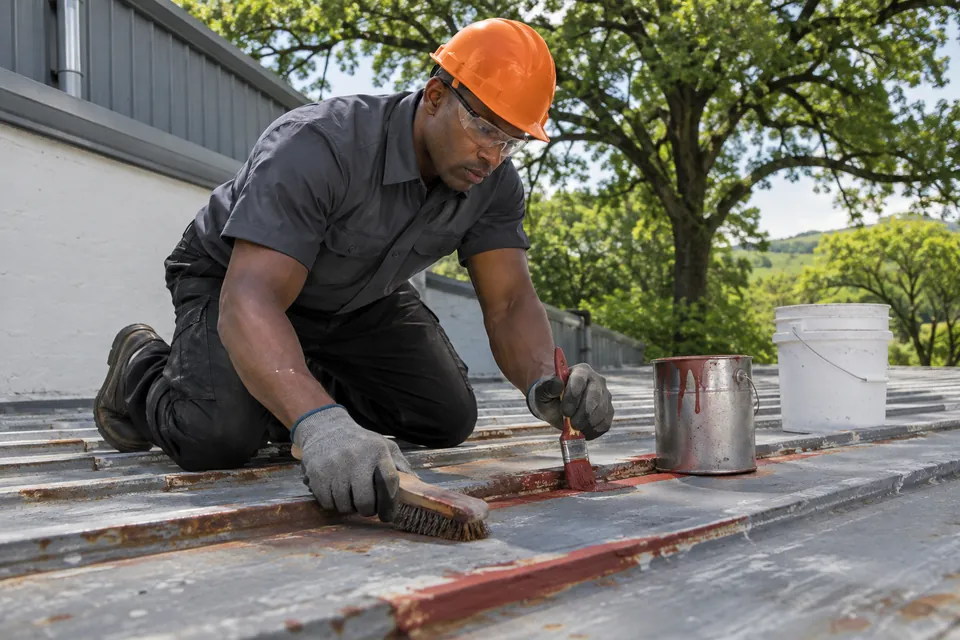
Omaha commercial metal roof coating works best on panels that are firm and dry underneath. Find your roof's condition below to see which job usually fits.
| What You See On The Roof | Coat Now | Repair, Then Coat | Replace First |
|---|---|---|---|
| Chalky factory paint, no leaks yet | Usually Fits | Sometimes | Rarely |
| Leaks at screws along the purlin lines | Sometimes | Usually Fits | Rarely |
| Rust bloom at end laps and cut edges | Sometimes | Usually Fits | Rarely |
| Panels rusted through in several bays | Rarely | Usually Fits | Sometimes |
| Condensation dripping in winter, not rain leaks | Rarely | Sometimes | Rarely |
These four conditions decide most of the prep on an Omaha metal building. Each gets repaired before a single field coat goes down.
Exposed screws back out as panels move with each season, and their rubber washers harden and split. We tighten the firm ones, swap stripped ones for oversized fasteners, and give every head its own detail coat.
Rust gets pressure-washed, wire-brushed, or ground until only firm steel remains. A rust-inhibiting primer matched to the coating system then goes on every bare or rusted spot before the base coat.
Laps open slightly every hot afternoon and cold night. Water wicks in along the rib, so each lap gets fabric or seam tape embedded in sealer to bridge that movement.
Penetrations through metal panels leak where flashing has lifted or sealant has cracked. We rebuild those details with fabric and mastic so they move with the panel around them.
Most metal roofs here take one of these four builds. The roof walk picks the one that fits your panels and drainage.
| Option | Where It Fits | Prep It Needs |
|---|---|---|
| Acrylic system over primer | Pitched R-panel that drains fast | Rust primer, screw work, lap fabric |
| Silicone system over primer | Low-slope metal with ponding at laps | Clean, prime, detail coat every lap |
| Butyl lap tape plus topcoat | Standing seam with failed seam sealant | Clean seams, tape, then two coats |
| Spray foam with topcoat | Leaky panels that need insulation too | Dry panels, mask intakes, set foam depth |
Coating keeps the panels you already own and closes every leak path in one film. Here is how that compares with re-sheeting the roof.
| Roof Factor | Coat The Roof | Replace The Roof |
|---|---|---|
| Planning cost | About $2.50 to $4.00 per sq ft | About $5 to $8 per sq ft |
| Production below | Keeps running; nothing opens into the building | Bays opened during panel swaps |
| Screw lines | Each screw sealed under the coating | New screws, new washers, same weak points later |
| Summer heat on the panels | Light topcoat reflects sun while clean | Depends on the new panel finish |
| Next round of upkeep | Clean and recoat the topcoat | Re-seal screws and laps as they age |
Call and tell us roughly how many leaks you see. We bring screws and sealant to the roof walk and mark every failed fastener.
Five stages, in this order, on every metal building we coat.
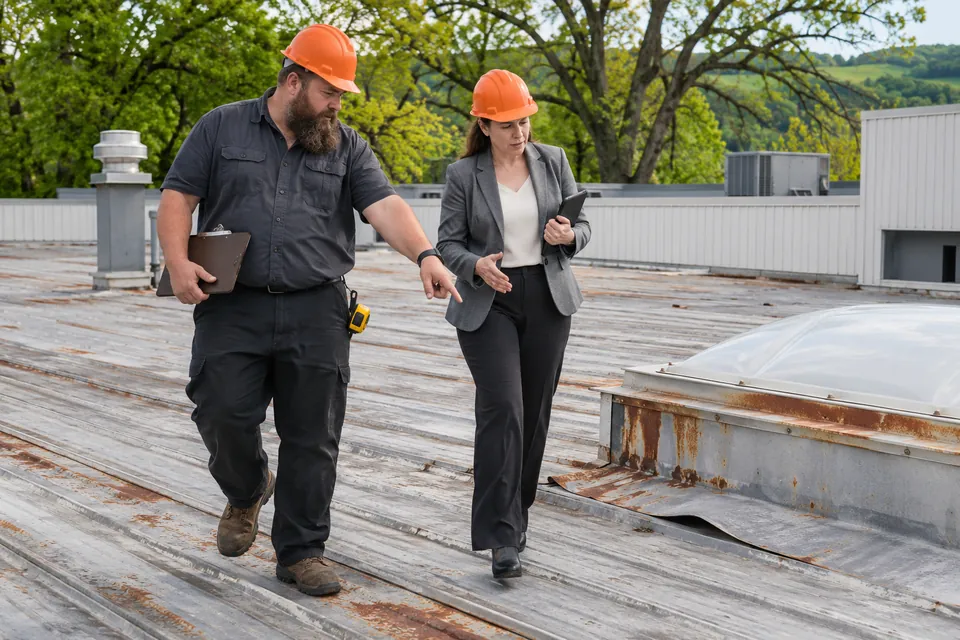
We walk each panel run, count failed screws, check laps and curbs, and take moisture readings anywhere insulation might be wet. Photos go into your written repair list.
Firm screws get snugged, stripped ones get oversized replacements, and missing ones are filled. On older roofs this step alone often stops half the leaks.
Pressure washing removes chalk and dirt; grinding takes off loose rust. Primer goes on bare and rusted steel right after grinding so flash rust has no time to form.
Side laps, end laps, ridge caps, and curbs get fabric or seam tape in a heavy detail coat, and every screw head gets its own cap of coating.
Field coats go on at the dry mil thickness the system calls for. Wet-mil checks during the work and a last walk catch thin spots before we leave.
Two related systems for metal roofs with special conditions, plus a shingle option for mixed buildings.
Low-slope metal sections that pond at end laps take silicone over the same primer and lap prep.
Silicone roof coatingMetal shops that leak and lose heat take foam over dry panels, with a UV topcoat over the foam.
Spray foam roofingOffice fronts with shingled mansards beside the metal shop roof can be coated in the same job.
Shingle roof coatingDirect answers for metal building owners and plant managers.
It means repairing and coating the metal roof you already have rather than tearing it off. Screws, laps, rust, and penetrations get fixed first, then base and top coats go on at a specified thickness.
Rust depth, the number of failed screws, how many laps need fabric, roof height and access, rooftop equipment, and coat count. Larger roofs spread setup over more area. Coating plans at about $2.50 to $4.00 per square foot.
Screws come first: snug the firm ones, upsize stripped ones, and seal every head. Laps get fabric in sealer, then the field coats cover panels and fastener lines together.
Yes in most cases. All work stays on the roof surface. We map air intakes and makeup air units first and schedule nearby sections for shutdown windows the plant picks.
Condensation forms under the panels when warm, moist air meets cold steel, and a topside coating leaves that untouched. Spray foam or interior insulation fixes it; we point out which drips are rain leaks and which are condensation.
Pressure washing, wire brushing, and grinding remove loose rust, scale, and chalky paint first. A rust-inhibiting primer matched to the coating then goes on every bare or rusted area. Skipping this step leaves moisture trapped under the film, which is how early peeling starts on metal roofs.
Standing seam roofs have hidden clips and few exposed screws, so the work centers on seam sealant, end laps, and penetrations. Butyl tape or fabric covers the seams before field coats. R-panel roofs need far more screw work, which changes both labor and price.
Units stay in place. Curbs get new fabric and coating, intakes are masked or shut down while their section is sprayed, and service panels stay reachable. Your HVAC contractor keeps its schedule, and we share the dates so nobody is surprised on the roof.
Send the building size and panel type. We walk the roof, count the repairs, and price the coating.